Station Eleven
by Emily St. John Mandel
Published June 2, 2015
Vintage Books, a division of Penguin Random House LLC.
Originally published by Alfred Knopf, a division of Penguin Random House LLC.
Read February 2016
333 Pages
Station Eleven came highly recommended from a trusted reading advisor. Two years later, it is still a book that makes me think and causes me to question what the future of humanity might look like. I don’t want to provide too much description because that is the beauty of this book. It unfolds in ways you don’t expect.
This is one of those books that I think EVERYONE should read. Perfect for middle school through adult and certainly one I plan on re-reading. A debut novel, St. John Mandel knocks it out of the park.
One of the things I love about this book is that it is dystopic without a government overthrow or violent war. It makes it seem so real, like the world event that causes a societal collapse could happen today. This is truly a book that shows just how fragile humans are and how incredibly delicate our everyday life experiences are. Showcasing the interconnectedness we take for granted, this book does a soul touching job of making you understand just how outstanding civilizations are and how quickly they can fall.
I think about this book almost daily. Twenty years from now, what foods would still be viable to eat from the abandon homes? How long would it take to re-learn basic medicine that relies on plants and natural remedies? Why does no one raid the library in “end of the world books” post-apocalypse? How long would the power grid last? What about everyone’s pets? Start down the rabbit hole and this book will give you plenty to think about and question your role in the world.
If you are stuck in a reading rut and want something to give you a kick start, Station Eleven is a book perfect for any mood and any time. You are going to want to own this one and re-read it. This book is on my top 10 favorite reads of all time. I hope you will agree.
Selected quotes: “Of all of them at the bar that night, the bartender was the one who survived the longest. He died three weeks later on the road out of the city.” Page 15
“People want what was best about the world.” Page 38
“hell is the absence of the people you long for.” Page 144
“What I mean to say is, the more you remember, the more you’ve lost.” Page 195
“She slipped away from them, walking alone for a hundred miles, whispering French to herself because all the horror in her life had transpired in English and she thought switching languages might save her.” Page 266
Need Reprint edition published April 4, 2017
Houghton Mifflin Harcourt
By Joelle Charbonneau
Started March 26, 2018
Finished March 29, 2018
Pages 338
Brief synopsis: Need takes place in the middle of a small Wisconsin town. The local high school students all receive a mysterious invitation to join a new social network called NEED. It is dark web meets real, everyday life. As students are asked to do ever more character changing tasks to receive what they think the need, the small community is struck by tragedy after tragedy. An interpretation of how selfish humans can be and a warning about how fast cyber bullying can take a turn to the unchangeable.
Why this book and why now: My oldest is in middle school. His school librarian posed a challenge to all the students to read a series of six pre-selected books. Need is one of those books. While my son had no interest initially, my friend’s daughter (and my son’s classmate) did. I challenged her to read it with me and the reward would be a special outing to a local ceramics shop. She had already read four of the six, but wasn’t too keen on finishing the challenge. Well, game on! She’s already halfway through after just a couple of days.
I wasn’t too optimistic about a young adult/juvenile fiction book about cyber bullying would keep my interest, but since I had a middle schooler and knew that social media wasn’t going away, I thought this book would be a good conversation starter with both my son and his classmates.
There is plenty of content to start those conversations. From parent/young adult relationships, suicide, taking responsibility for your actions, and the importance of trust, if you have a teenager, it should be easy to find a story line to get your teen talking.
The overall pace and feel of the book had a Maze Runner meets Hunger Games on the internet vibe. Charbonneau introduced a lot of characters one short chapter at a time. There were so many characters and they did not spend much time face to face interacting that it was difficult to remember who was who. More time on developing the social structure and the who’s who at the beginning would have made it easy to understand the nuances that Charbonneau was trying to explain with characters like Jack and Gina . Their perception of self likely is very different then how their classmates viewed them and I think that would have added to the story development.
There were a few trigger topics that I was surprised to come across in the books. Especially for Bryan who had thoughts of suicide and discussed the methods he had considered. I would want any parent to know that this topic is broached in this book so that you can have a conversation with your pre-teen or teen. Having sons, I do worry that heartbreak or not meeting expectations and the resulting emotions will lead them to consider things with irreversible consequences.
Other difficult topics include, death of a parent, death of a classmate, anaphylaxis due to food allergies, adultery, siblings with a potentially terminal disease, murder, deceit and lying.
Recommended reading for: While this book was suggested to middle school students, I would err on the side of 8th graders and older. The book revolves around high school students and the topics discussed are geared more toward a young adult stage of life. The romantic relationships are not physical, surprisingly so considering the number of times the teens are left alone.
If you are looking for a way to have a conversation with your kid about online behavior or just looking for a way to connect, this should be a book they are interested in reading and one that keeps a parent turning the pages without too many eye rolls.
The final word: Needdoes not leave me needing more, but I am optimistic that it will give me a segue into deeper conversations with my son and his peers. Based on the pace and depth of the book, I think Charbonneau absolutely meets her target audience of young teens, giving them just enough to think about without the complication of overdone scene set ups. She takes advantage of their assumptions as to how a high school social structure works and allows them to project their own experiences within the story likely making the characters more relatable to them since they are filling in some of the gaps Charbonneau allowed.
Iron Man cross-stitch. Work in progress. Will be 8×10 and 70k stitches when complete!
I’ve been a little slow to start on my reading challenges for 2016, let alone finding time to write more than one sentence at a time. Call me distracted, I’ve been working on a cross-stitch of Iron Man, an American Flag full size crochet quilt, trying (and failing) to launch a handicrafts store, Leslie A Curry-Handicrafts, Crochet, and Mosaic, and trying to manage a chaotic phase of life. What better way to multi-task while reading than to use an audiobook? Wild: From Lost to Found on the Pacific Crest Trail by Cheryl Strayed had been highly recommended by one of my girlfriends a couple of years ago, so when it was available through my public library’s electronic catalog, I decided it was time to give it a go.
Why this book and why now:
I started listening to this Wild (315 pages) as a distraction during a dental appointment for a crown prep. A few minutes in, and I wasn’t sure it was the right choice. Graphic detailing of toenails falling off didn’t help much to distract me from the pain and discomfort of the drilling happening in my mouth.
The story of Cheryl’s relationship with her mother and the process of losing her pulled me in for what I anticipated to be a much different story. Many of the details of this book have left me since I read it back in January, but much of what I remember has to do with Cheryl making one mind-boggling decision after another in regards to her personal safety. I understand that Cheryl was dealing with depression and perhaps some PTSD after her childhood experiences. I wish more of the book and self exploration acknowledged these traumas. Instead, Cheryl continued to put herself in one dangerous situation after another without drawing any understanding to the idea that she was actually perhaps suffering from some very big emotional issues. I was mystified that while waiting for a DJ she just met at a random club to get off work for their “date” that she willingly went into a strange man’s van to smoke weed. After which she traipses off with the DJ to his house way out in the middle of nowhere to hopefully have sex. All the while, no one knew where she was or who she was going with. This is after she dabbled with heroine or meth after leaving her self-admitted very good husband.
I understand that everyone’s personal journey is different and that the ways we each cope with stress, anxiety, depression, joy, fear, you name it, can be expressed or experienced in absolute contradiction to how another copes. I wish for Cheryl, that she had had someone who would have helped her find a safer way to deal with her mother’s death and need for self discovery. I’m still trying to understand why Cheryl felt it was acceptable to cause her body so much harm and pain in forcing her way through the PCT. Many of her stories in the book graphically describe her feet that were mangled, scabs and bruises that took weeks to heal, drastic dehydration. This is not heroic in my opinion, this is self-mutilation.
I am glad for Cheryl’s sake that her story has a peaceful ending. I’m grateful that for all the seedy situations she put herself in, she walked away unharmed by another human during her trek.
Recommended reading for: This is not a book I would recommend, however, if you are looking for a memoir about a young woman who is able to come out the other side of some questionable choices, then you might want to give this one a try. I’d recommend two books on a similar topic before this one: The Glass Castle: a Memoir by Jeanette Walls or The Girls’ Guide to Hunting and Fishing by Melissa Bank
The final word: I’m certainly glad I experienced Wild as an audiobook. Had I been reading it in book form, I am almost certain it would have been added to my “won’t ever finish” list on goodreads.
So about that promised review of Marie Kondo’s The Life Changing Magic of Tidying Up, I suppose it is past due. And those promised photos? Didn’t happen. Here’s why. I didn’t find the book as helpful as I had hoped. I didn’t like reading the book, it took me six months to finish and it would have been longer if I hadn’t been trying to beat my friend (see his book blog here) in our annual book challenge. The very top of the trees concepts of only keeping things or buying things that truly bring you joy were certainly worth some meditation. The writing in this book? Left much to be desired, I’ll give her the benefit of the doubt and chalk it up to “lost in translation”. I believe this book is better classified as a memoir than an actual self-help book. Most of the book is spent reflecting on Kondo’s own life and thoughts rather than the practical application of her technique.
The most helpful part of the book was the revelation that some (read: many) of us were never actually taught how to tidy. This point was a bit of a gut check as I recalled how often I reprimanded my sons for not tidying their rooms well enough. Shortly after reading this passage, I did a little decluttering session with my 9 year old and his dresser drawers. I sensed he was keeping some clothes only because he thought I wanted him to keep them, so I set the record straight. I told him to clean out all his drawers and only keep the items he knew he would wear and the ones he really liked. We went through each piece of clothing together and when I thought he was keeping it to please me, I reminded him he would not offend me by making his room more pleasing to him. We got rid of a lot of clothes! It also helped me to see what sort of style he preferred.
We were so successful with his clothes, my husband and I set to work on all the books in both of our sons’ rooms. We emptied both of their bookshelves onto the kitchen table. MOUNDS of books! I knew we had a lot, but it was a little shocking to see it all laid out. And wouldn’t you know, we had duplicates! Books, especially books in the library of my growing and varied children, are hard for me to let go of, however by making my boys part of the process we got rid of two paper boxes of books. This lead to them reading more on their own since their book shelves weren’t busting at the seams, ready to spill on top of them lest a jenga tile be removed too quickly.
Speaking of books, Kondo’s whole section dedicated to books was one section that provided a new outlook on decluttering my library. A couple of Kondo’s observations worth mentioning:
“You read books for the experience of reading. Books you have read have already been experienced and their content is inside you, even if you don’t remember it.” Page 89
Books to Keep “The most difficult ones are those that give you moderate pleasure–those with words and phrases that moved your heart and that you might want to read again.” Page 93
Since starting this blog (and my reading notebook, the source of most of this content), it has become much easier to pass along a book. I have captured the emotions the book made me feel. And I have a very tangible, detailed list of what I have ready, why I have read it, what it has taught me. My bookshelves are lighter since starting this blog because I am able to “keep” those parts of the books that have changed me.
“The moment you first encounter a particular book is the right time to read it.” Page 95
The final word: This is not a book I particularly enjoyed reading. It is only because of writing this post that I realize how much I did in fact learn. Ideally, Marie Kondo’s newest book, Spark Joy will address some of the practical implication parts that were missing from this book. This book is a good fit for someone just getting started with decluttering or who does not have a lot of practice with minimalism. Other Selected Quotes:
“Order is dependent on the extremely personal values of what a person wants to live with.” Page 6
“I’m sure many of us have been scolded (during our childhoods) for not tidying up our rooms, but how many of our parents consciously taught us how to tidy as part of our upbringing?” Page 10
“You only have to experience a state of perfect order once to be able to maintain it.” Page 30
“We should be choosing what we want to keep, not what we want to get rid of.” Page 41
“It is actually our rational judgement that causes problems.” Page 59 Malcolm Gladwell wrote an entire book on this concept Blink: The Power of Thinking Without Thinking. I listened to it as an audiobook in 2014.
“The true purpose of a present is to be received. Presents are not “things”, but a means for conveying someone’s feelings.” Page 108
Ape House
Published September 2010
Spiegel & Grau a division of Random House, Inc. by Sara Gruen
Started May 31, 2015
Finished June 18, 2015
306 Pages
Brief synopsis:
John Thigpen meets some extra-ordinary Bonobos apes for a newspaper assignment. Little does he know just how important this assignment will become to the bonobos. After his writing partner, Cat Douglas, steals his story, the ape research facility where he met Bonzi, Lola, Jelani, Makena, Sam, and Mbongo becomes the site of a malicious bombing. What happens to the apes and their dedicated care taker, Isabel Duncan, is a story of betrayal, dedication, and the fight for those without a voice. Ape House is the story of how pure intentions and collaboration often lead to our biggest rewards in life.
Why this book and why now: I picked up Ape House at the same time that I grabbed Counting by 7s. At the time, I was looking for a novel to escape and provide some reprieve from the cycle of grieving my grandmother’s passing. I had very much enjoyed Sara Gruen’s Water for Elephants so Ape House seemed an obvious choice while wandering the library bookshelves.
Frankly, this book is not about what I expected it to be. One of the first quotes I captured was, “Bonobos—along with dolphins and humans—are the only animals known to have recreational sex.” Page 10. This fact was new to me and I found it rather interesting. I did not expect the book to spend so much time focused on exploiting the sexuality of the apes. The more I read the book, I was remembered the sexual undertones in Water for Elephants. By no means am I trying to insinuate that I am a prude or am disturbed, embarrassed, or otherwise finger wagging at the topic, but the fact that the apes’ sexuality is such an integral part of the storyline was surprising and took a while to accept and adjust to while reading. I’m curious to know more about why Sara Gruen has chosen sexual experiences to be the lens through which she tells her stories, well at least the two that I have read so far (At the Water’s Edge is on my to-be-read list).
One topic that this book has made me more aware of over the last few weeks is that of animal testing. There is a scene in the book where Isabel Duncan visits a notorious chimp/ape research facility. During her experience on the inside Isabel learns of some of the tests the primates are subjected to including cancer research, mother/child bonding, etc. I am going to assume Gruen has done her research and that the experiments referenced are based on some form of actual tests being conducted on animals. As I’ve mulled this part of the story line over, it has made me wonder just how much harm has been done to animals in the name of medicine, food safety, and psychological understanding. I’ve recently started to cut out “mammal meat” from my diet as I have become more aware of the conditions and methods that cattle and hog farms use to raise these animals. And it also is becoming harder to justify eating something of my own classification. (No, I am not judging you or trying to subversively get you to stop eating your bacon cheeseburger.) I think I am going to save total awareness of animal testing for a little further into my journey to going mostly vegetarian.
One of the sub stories in the book revolved around John Thigpen’s wife, Amanda. Personally, I did not care for the way that Gruen portrayed Amanda. I think she wrote Amanda in a cliché fashion and solved Amanda’s problems with a stereotypical cliché. The last chapter of the book had me rolling my eyes as Gruen wrapped up all the loose ends from her story lines.
Recommended reading for: Ape House is certainly a book for adults. There are some themes that made this book interesting such as that of the way humans treat animals, human fascination and simultaneous embarrassment regarding sex, and the value of unexpected friendships.
The final word: The Author’s Note in Ape House is what redeemed the book for me. When I learned that Sara Gruen actually visited with bonobos apes and spoke with them, much as her main character did, I was suddenly much more interested. I wish Sara would have written more from this perspective and left some of the highly unlikely scenarios out or at least made them a little more believable. Again, I’m thinking of the way Amanda Thigpen was written and also the pizza parlor scene. This is very likely not a book I would look to reread nor is it a book I would think first to recommend.
A final note: While I may not list this book as one of my favorites or even as one I fully enjoyed reading, I have huge amounts of admiration and respect for any author. The discipline, research, persistence, dedication, and crazy amounts of time it takes to get a whole book written and published is admirable! The process of writing these few blog posts have opened my eyes to the huge level of commitment it takes to write something of quality and worth. The risk an author takes in putting their work out for the world to critique is amazing. I am grateful that so many author’s continue to produce new works, I’ve learned so much because of them all!
New words learned: By default, all definitions for new words learned are sourced from Webster.com
Virtuosic (Page 10): a person who does something in a very skillful way Crepitus (Page 22): popping and cracking noises of the joints Soupcon (Page 35): a small amount of something Prurient (Page 97): having or showing too much interest in sex Occlusion (Page 135): the obstruction of the breath passage in the articulations of a speech sound Oeuvre (Page 141): all the works that a writer, an artist, or a composer has created Papadum (Page 227): a thin, crisp disc-shaped Indian and Pakistani food typically based on a seasoned dough made from black gram, fried or cooked with dry heat.
After looking up all of the new words I collected along the way, I question some of Gruen’s word choice. In the places that she used virtuosic (page 10) and papadum (page 227), assuming the webster definitions that I sourced are in alignment with her intention, the words just don’t seem to fit.
Selected quotes: “Bonobos—along with dolphins and humans—are the only animals known to have recreational sex.” Page 10
“We are, all of us, collaborators. We are, in fact family.” Page 10
Wouldn’t it be amazing if more of us thought about the world around us in such a way?
“The business of a newspaper is to comfort the afflicted and afflict the comfortable.” Page 34
I wish we could get the majority of the news media back to this in a less sensationalized way. There are many stories and humanitarian issues that could benefit from some compassion and helpful calls to action rather than the repeated reporting with no proffered solutions.
Have you read Ape House? Let me know what you think in the comments section.
Since I started this book journal in the middle of the year, there are about 16 books I’ve already read that won’t get the full morethanabookreview.com treatment. Some of these titles include books by my favorite authors and also one of my new favorite books! Landline is one of those books, written by one of my current favorite authors, Rainbow Rowell. While it may not include all of my first reactions, it stuck with me enough to be able to write this reflection.
Landline by Rainbow Rowell
Landline by Rainbow Rowell (Publication July 8, 2014)
Finished reading January 2015
Brief synopsis: Landline is a story about a marriage in trouble. Georgie McCool and her husband, Neale, have been together since college. Georgie puts in long hours writing a sitcom while Neale cares for their two daughters. As the pressure of her career continues to impact her family life, Georgie is faced with some difficult decisions when Neale leaves at Christmas to visit his family and takes the girls along. The plot line is further complicated by the fact that Georgie’s work partner is her long-time college friend, Seth. Much of the story centers on a seemingly magical, bright yellow landline phone that allows Georgia to communicate with the past.
Why this book and why January 2015: Landline was my first book of 2015. I was on a bit of a Rainbow Rowell kick after reading Attachments, Eleanor & Park, and Fangirl. This was the last Rowell book I had to read and I was very eager to do so. Rainbow’s book Attachments is one of the first books I recommend to any of my girlfriends that ask. That book had me laughing so hard I was crying a mere three pages in! As I mentioned in my About Page, Rainbow Rowell is one of my current favorite authors.
The time frame of the story is around Christmas, the fact that I was reading it just after the holidays was entirely coincidental, however being surrounded by snow, family, the looming date of going back to work, did very much help me relate to Georgie in ways that reading this book during the summer would have made different.
At one point in this book, Georgie sees snow for the first time. Growing up in the Midwestern United States, I found it a bit mind boggling that another American had never experienced snow before! I’m sure there are lots of people in the United States that have never touched snow, I just had never even consider the fact. This part of the book was a lot of fun to read as Rainbow Rowell described what her character experienced when she touched snow, leaving an imprint of her hand and being amazed by it. Which makes me wonder, what is something that you, reading this right now, have never experienced that others might be surprised by? Leave a comment using the link at the top of this post to share.
One of the reasons I enjoy Rainbow Rowell’s writing so much, is that her characters are realistic. She lets us inside the minds of these characters and what we find is a “normal” person, not some highly dramatized version of a person facing a difficult life situation. Georgie McCool’s, thoughts and feelings about her family, husband, career, friendships, and marriage are relatable and believable.
Recommended reading for: Landline is a perfect read for young adult or grown adult. If you are looking for a book that provides another perspective on the difficulties of navigating a marriage, this is a book worth reading. The relationships among the female characters in the book remind me of my relationship with my mom and sister in different ways. A great book overall that I don’t think you will be disappointed with reading.
Started May 18, 2015
Finished May 30, 2015
Pages: 380
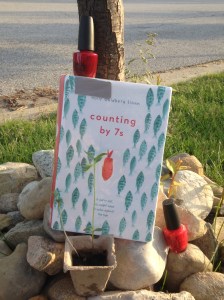
Brief synopsis: Middle school student Willow Chance was adopted as an infant. She’s an exceptionally intelligent child with a deep love and understanding of plants and medicine. Willow gets abruptly “repotted” due to a family catastrophe. Surrounded by new found friends, Willow learns how to replant herself while inspiring others along the way. Her favorite number is 7, will it prove to be lucky?
Why this book and why now: My grandmother passed away on May 16. Feeling out of sorts and realizing I hadn’t read a book in three weeks due to ICU visits, I went to my local library. This is where Willow Chance, the main character of County by 7s and I found our first connection because “books=comfort, to me anyway.” (page 151). The librarians at our local branch are wonderful! Through the years, our family has built a great relationship with our librarians and they know just what our family is looking for when we ask for a referral. When I explained my heartache and the recent passing of my grandmother, one of my favorite librarians quickly pulled Counting by 7s, a juvenile fiction piece, off the shelf. I’m told that the fact that she shares the main character’s name had nothing to do with the referral.
Within the first few chapters, the main character is dealt a shocking loss. I almost put the book down at this point, this is not what I had in mind for distracting myself from the still fresh loss of my grandmother. However, I trusted my librarian’s referral, so I pushed through the emotion.
One of the great themes of this book is that even as Willow Chance is aching and trying to find a new normal, she was also inspiring others. She was making the lives of other people better even though her world was the worst it had ever been. The impact of this lesson is enhanced by the fact that Willow doesn’t even realize she’s having such a profound effect on those around her. I think it is that way for all of us. Just by being the person we are and dealing with adversity the way we have learned to and are wired to, leads others to have strength and courage even when we feel like we have none.
After the decision was made to take my grandmother off of the ventilator that she had been on for a week with no improvement, the hardest part was the waiting. Those five hours in the waiting room could have easily been as many days. So when I read this quote from Counting by 7s, “A second can feel like forever if what follows is heart break.” (Page 351), I knew exactly what she meant. No one wants to hurry heartbreak, so somehow we manage to make those seconds feel like minutes, the hours to feel like days. That’s probably why it’s so quite when a person is waiting for heart break. Again, young Willow said it best, “And that is why the deepest form of pain comes out as silence.”(Page 175)
There is one final quote that made me stop and meditate on the truth of it. It is, right now, one of my favorite sentiments. “I’m not brave; it’s just that all other choices have been thrown out the window.” (Page 360) I love the sense of resiliency that this quote made me feel, especially as I reflected on the events of the past couple of weeks. The idea behind this quote, that even when you feel the situation is scary and new and unpleasant, there is always bravery. There is always a chance to move past the experience by facing it head on, with a sense of power and control.
Recommended reading for: While this book is typically recommended for 4-6 graders, this book is also an excellent read for adults. It gives us a perspective on the impact adults have on their children and the children that enter our lives in many different ways. For adults it also provides us an opportunity to reflect on the way we are impacted by children.
If your young reader is going to give this one a read, I do recommend you read it as well. There were a few concepts that might cause some anxiety to children who are on the younger end of the spectrum. For instance, a young reader may benefit from an explanation that the chances of becoming suddenly orphaned are not that great. There are lots of opportunities to discuss why certain families or people make the life choices that they do. The book also opens the door for parents to celebrate their own child’s unique interests. Willow’s uniqueness and her confidence are what help to inspire change in so many others.
The Final Word: Counting by 7s is a book I look forward to sharing with my sons as they get older. It is also a book I look forward to rereading with them. Certainly worth reading if you are looking for great writing, a thought provoking story, and a little inspiration.
New words learned: Onomatopoetic (page 10) -The creation of words that imitate natural sounds
Chiropterophily (page 23) – Pollination of plants by bats
Dysphagia (page 125) – medical term for not being able to swallow
Crypsis (page 153) – hiding
Selected quotes: This one inspired me to clean out my sons’ pajama drawers, low and behold we probably had enough PJs for each kid on our block! Their grandparents seem to also like gifting “cozy” PJs.
“From my observation, the older you get, the more you like the word cozy.
That’s why most of the elderly wear pants with elastic waistbands. If they wear pants at all. This may explain why grandparents are in love with buying grandkids pajamas and bathrobes.” (Page 33)
These quotes very much resonated with me during this particular time in my life experience. I wanted to share them with you in hopes that they might provide you the same sense of not feeling quite so alone.
“I’m hiding in plain sight, which is often the best way to be concealed.” Page 153
“And that is why the deepest form of pain comes out as silence.” Page 175
“Just being there is ninety-nine percent of what matters when your world falls apart.” Page 175
“A second can feel like forever if what follows is heart break.” Page 351
“I’m not brave; it’s just that all other choices have been thrown out the window.” Page 360


 I’ve been a little slow to start on my reading challenges for 2016, let alone finding time to write more than one sentence at a time. Call me distracted, I’ve been working on a cross-stitch of Iron Man, an American Flag full size crochet quilt, trying (and failing) to launch a handicrafts store,
  The story of Cheryl’s relationship with her mother and the process of losing her pulled me in for what I anticipated to be a much different story. Many of the details of this book have left me since I read it back in January, but much of what I remember has to do with Cheryl making one mind-boggling decision after another in regards to her personal safety. I understand that Cheryl was dealing with depression and perhaps some PTSD after her childhood experiences. I wish more of the book and self exploration acknowledged these traumas. Instead, Cheryl continued to put herself in one dangerous situation after another without drawing any understanding to the idea that she was actually perhaps suffering from some very big emotional issues. I was mystified that while waiting for a DJ she just met at a random club to get off work for their “date” that she willingly went into a strange man’s van to smoke weed. After which she traipses off with the DJ to his house way out in the middle of nowhere to hopefully have sex. All the while, no one knew where she was or who she was going with. This is after she dabbled with heroine or meth after leaving her self-admitted very good husband.


 morethanabookreview